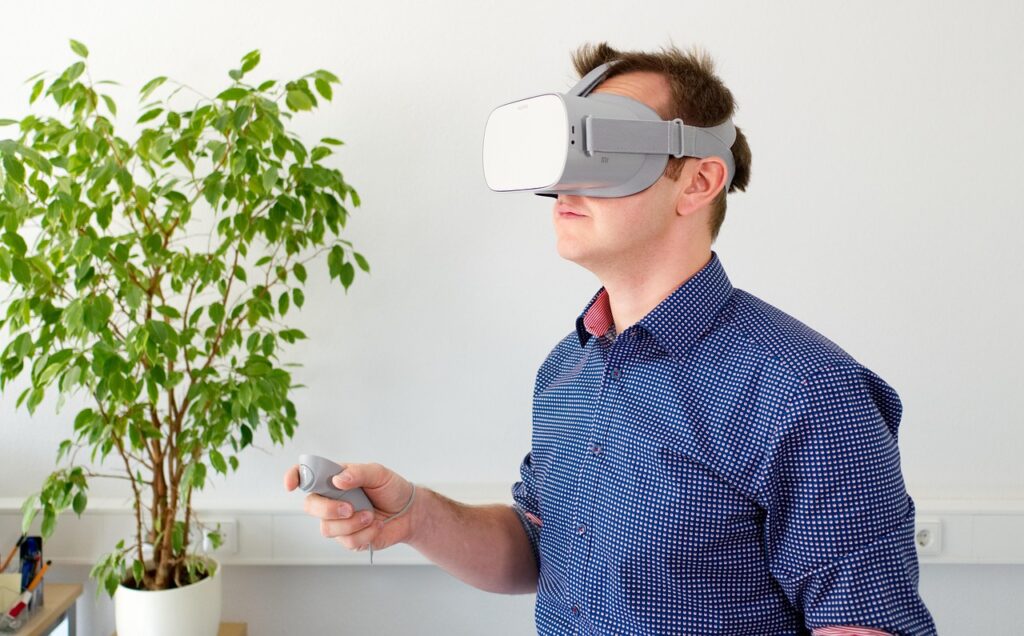

In a small café in Tokyo, a group of friends stumbled upon a unique experience – their coffee cups came to life with animated characters and stories, all thanks to an augmented reality (AR) application on their smartphones. This wasn’t just a gimmick; it was a glimpse into how AR can merge the digital and physical worlds seamlessly. As they explored this technology further, they found numerous examples of AR being used in education, healthcare, and even in the workplace. For instance, the medical school at the University of California, Los Angeles (UCLA), uses AR to help students practice surgeries in a highly realistic environment. Similarly, companies like Boeing use AR to guide their workers through complex assembly processes, significantly reducing errors and increasing efficiency.
The potential of AR to enhance learning, improve work processes, and create engaging experiences is vast. Consider the case of IKEA, which launched an AR app allowing customers to see how furniture would look in their homes before making a purchase. This not only enhanced the customer experience but also reduced the likelihood of returns. With AR, the possibilities seem endless, from enhancing museum visits with interactive exhibits to helping architects visualize building designs in real-world settings.
However, like any emerging technology, AR also presents its set of challenges, including the need for high-quality content, the cost of development, and concerns over privacy and security. As AR continues to evolve, addressing these challenges will be crucial for its widespread adoption. For now, let’s dive deeper into the world of augmented reality and explore what makes it tick.
As the technology advances and becomes more accessible, the line between the physical and digital is becoming increasingly blurred. Whether it’s through smartphones, tablets, or specialized AR glasses, the ability to overlay digital information onto the real world is opening up new possibilities for interaction, education, and entertainment. With major players like Apple, Google, and Microsoft investing heavily in AR, it’s clear that this technology is here to stay.
But what exactly is augmented reality, and how does it work? To understand the complexity and potential of AR, let’s first look at a real-world example. The city of Singapore has launched an AR tour that allows visitors to explore its historic district with a new level of depth, providing information on landmarks, cultural significance, and even interactive stories. This example illustrates how AR can enhance our daily experiences, making them more engaging and informative.
📝 Article Overview
Understanding Augmented Reality
Augmented reality is a technology that enhances the real world by overlaying digital information and images onto it. Unlike virtual reality, which creates a completely artificial environment, AR aims to enrich the real world, making it more interactive and informative. The concept of AR has been around for several decades, but recent advancements in smartphone technology and the development of AR-specific hardware have made it more accessible and user-friendly.
To illustrate the difference between AR and other technologies like virtual reality (VR) and mixed reality (MR), consider the following comparison: other technologies like
| Technology | Description | Examples |
|---|---|---|
| Virtual Reality (VR) | Completely immersive digital environment. | Gaming, simulation training. |
| Augmented Reality (AR) | Overlay of digital information on the real world. | Pokemon Go, IKEA Place app. |
| Mixed Reality (MR) | Combines elements of AR and VR, interacting with both physical and digital objects. | Microsoft HoloLens experiences. |
Understanding the nuances between these technologies is crucial for developing and implementing effective AR solutions. For instance, a company looking to create an immersive training program might opt for VR, while one aiming to enhance customer shopping experience could use AR. The choice between these technologies depends on the specific goals and needs of the application.
Leading Augmented Reality Solutions
1. Education and Training
The field of education is one of the most promising areas for AR application. By making learning more interactive and engaging, AR can significantly enhance student outcomes. For example, AR can be used to create 3D models of complex structures like the human body or historical monuments, allowing students to explore them in detail. This interactive approach to learning can increase student engagement and retention rates. most promising areas
In detail, educational AR solutions can range from simple apps that provide interactive textbooks to complex simulations for professional training. The University of Maryland, for instance, has developed an AR system for teaching anatomy, where students can explore the human body in 3D, layer by layer. This level of interactivity not only makes learning more fun but also provides a deeper understanding of complex subjects. provide interactive textbooks
- Key Benefits:
- Enhanced engagement and interactivity in learning.
- Improved retention and understanding of complex subjects.
- Availability of interactive 3D models for better comprehension.
2. Healthcare and Medicine
In the healthcare sector, AR is being used to revolutionize patient care and medical training. For example, surgeons can use AR glasses to get real-time information about a patient’s anatomy during an operation, reducing the risk of complications. Similarly, AR can help patients understand their conditions better by visualizing their treatments and medications in 3D.
AR is also being applied in medical education to provide students with realistic and interactive training experiences. For instance, AR can simulate surgeries, allowing medical students to practice and hone their skills in a controlled environment. This not only reduces the risk associated with real-life surgeries but also provides a more immersive learning experience.
- Key Benefits:
- Enhanced precision and safety in surgical procedures.
- Improved patient understanding and engagement with their treatment plans.
- Realistic and interactive medical training for students and professionals.
3. Retail and Marketing
The retail industry has seen significant benefits from AR, particularly in enhancing the customer shopping experience. With AR, customers can see how products would look in their homes before making a purchase, reducing the likelihood of returns. Additionally, AR can provide customers with detailed product information, reviews, and demos, making the shopping process more informed and engaging.
Companies like Sephora and IKEA are already using AR to offer virtual try-on features and in-home previews of their products. This not only enhances customer satisfaction but also provides valuable insights into customer preferences and behaviors, helping companies to tailor their marketing strategies more effectively.
- Key Benefits:
- Enhanced customer shopping experience through interactive product demos.
- Reduced returns through better product visualization.
- Valuable customer insights for targeted marketing strategies.
4. Architecture and Real Estate
In the field of architecture and real estate, AR is being used to revolutionize the way buildings are designed, marketed, and sold. Architects can use AR to visualize and share their designs in 3D, allowing clients to see how a building would look in real life. This can significantly reduce misunderstandings and miscommunications between architects, clients, and contractors.
Real estate agents are also leveraging AR to provide potential buyers with immersive property tours. By overlaying digital information onto real-world settings, AR can highlight the features and amenities of a property, making the viewing process more engaging and informative. This can lead to faster sales and higher customer satisfaction.
- Key Benefits:
- Improved communication and understanding between architects, clients, and contractors.
- Enhanced property viewing experiences for potential buyers.
- Faster sales and higher customer satisfaction in real estate.
5. Industrial and Manufacturing
In industrial and manufacturing settings, AR is being used to improve efficiency, reduce errors, and enhance worker safety. Companies like Boeing and General Electric are using AR to guide workers through complex assembly processes, providing them with real-time instructions and feedback.
AR can also be used for remote maintenance and repair, allowing experts to guide local technicians through complex procedures remotely. This can significantly reduce downtime and improve overall productivity. Additionally, AR can enhance worker safety by providing them with critical information about their environment, such as potential hazards and safety protocols.
- Key Benefits:
- Improved efficiency and accuracy in manufacturing processes.
- Reduced errors and enhanced worker safety.
- Remote maintenance and repair capabilities for reduced downtime.
Why People Are Paying Attention
✔ Enhanced Learning Experiences Enhanced Learning Experiences
AR’s ability to make learning more engaging and interactive is one of the primary reasons it’s gaining attention. By providing a more immersive experience, AR can increase student engagement and retention rates, leading to better educational outcomes. This is particularly significant in subjects like science, technology, engineering, and mathematics (STEM), where complex concepts can be difficult to grasp through traditional teaching methods. make learning more
✔ Improved Customer Experiences
Companies are also paying attention to AR because of its potential to revolutionize customer experiences. Whether it’s through virtual try-ons, in-home product previews, or interactive product demos, AR can provide customers with a more informed and engaging shopping experience. This can lead to higher customer satisfaction, reduced returns, and increased brand loyalty.
✔ Increased Efficiency in Operations
In industrial and manufacturing settings, AR’s ability to guide workers through complex processes and provide real-time feedback is a significant draw. By improving efficiency and reducing errors, AR can help companies increase productivity and reduce costs. This is particularly important in competitive industries where operational efficiency can be a key differentiator.
✔ Enhanced Safety and Training
AR’s application in safety training and emergency response is another area gaining attention. By providing realistic and interactive training experiences, AR can help prepare workers for emergency situations and reduce the risk of accidents. This is critical in high-risk industries such as construction, oil and gas, and healthcare.
✔ New Business Models and Revenue Streams
Finally, AR is opening up new business models and revenue streams for companies. Whether it’s through the development of AR-based products and services, the creation of AR experiences for marketing and advertising, or the sale of AR hardware and software, the potential for growth is vast. Companies that embrace AR early on can position themselves for success in this emerging market.
✔ Investment and Funding Opportunities
The growth of AR is also attracting significant investment and funding. Venture capitalists, startups, and major corporations are all investing in AR technology, indicating a strong belief in its potential. This investment is crucial for driving innovation and adoption, as it supports the development of new AR applications and hardware.
The Next 5 Years
- Predicted Widespread Adoption of AR Glasses
- Expansion of AR in Education
- Increased Investment in AR Technology
- Development of More Sophisticated AR Content
- Integration of AR with Other Technologies
Over the next five years, AR glasses are expected to become more mainstream, with several companies, including Apple and Google, rumored to be working on consumer-friendly models. This could revolutionize the way people interact with information, making AR a seamless part of daily life. As the technology advances, we can expect to see more sophisticated AR glasses that are not only stylish but also powerful, offering a wide range of applications from entertainment to education. next five years
The use of AR in education is expected to expand significantly, with more schools and universities adopting AR-based curricula. This could lead to a significant improvement in educational outcomes, as AR has been shown to increase student engagement and understanding of complex concepts. Educational institutions will need to invest in AR technology and training for teachers to fully use its potential, which could include developing customized AR content and integrating AR into existing curricula. universities adopting ARbased
As the potential of AR becomes more apparent, investment in AR technology is expected to increase. This could lead to breakthroughs in areas such as AR hardware, software, and content creation, further accelerating the adoption of AR across various industries. Companies will need to stay ahead of the curve by investing in AR research and development, partnering with AR startups, and exploring new business models that use AR.
The next five years will also see the development of more sophisticated AR content, including interactive stories, games, and experiences. This could lead to new forms of entertainment and engagement, as AR becomes a primary platform for storytelling and interaction. Content creators will need to push the boundaries of what is possible with AR, experimenting with new formats, genres, and technologies to create immersive and interactive experiences.
Finally, the integration of AR with other technologies such as artificial intelligence (AI), the Internet of Things (IoT), and blockchain is expected to increase. This could lead to the creation of even more powerful and immersive AR experiences, as well as new applications and use cases for AR. For instance, integrating AR with AI could enable more personalized and adaptive AR experiences, while integrating AR with IoT could enable more seamless interactions between the physical and digital worlds.
| Year | Predicted Advancements | Expected Impact |
|---|---|---|
| 2023 | Improvements in AR hardware and software. | Increased adoption of AR in consumer markets. |
| 2024 | Expansion of AR in education and training. | Significant improvement in educational outcomes. |
| 2025 | Development of more sophisticated AR content. | New forms of entertainment and engagement. |
| 2026 | Integration of AR with other technologies. | Creation of more powerful and immersive AR experiences. |
Worth Remembering
Augmented reality is not just a technology; it’s a way to enhance and interact with the real world. Its applications are vast, from education and healthcare to retail and manufacturing. As AR continues to evolve, it will be important to remember its potential to transform industries and daily life. The future of AR is promising, with predictions of widespread adoption, expanded use in education, and the development of more sophisticated content and technologies.
The integration of AR with other emerging technologies will also play a crucial role in its development, enabling more complex and interactive experiences. As companies and individuals begin to explore the potential of AR, they must consider the challenges and limitations of this technology, including the need for high-quality content, the cost of development, and concerns over privacy and security.
Ultimately, the success of AR will depend on its ability to provide real value to users, whether through enhanced learning experiences, improved customer experiences, or increased efficiency in operations. As the technology advances and becomes more accessible, the possibilities for AR will continue to grow, transforming the way we live, work, and interact with the world around us.